
When you buy at Sofi Lakes, you're making a decision about more than just your home. Your address, your school district, and your county all flow from the same choice. And that choice affects your property tax bill year after year. Because Sofi Lakes is located in Waller County, your taxes follow Waller County rules, not Katy ISD rules. It's a detail that matters.
Start with the number itself. According to co.waller.tx.us, Waller County's property tax rate for 2025 is 1.0760 per $100 of assessed value. That rate funds county operations, emergency services, and infrastructure. It's only one piece of your bill, though. What you pay depends on every taxing entity that serves your address, and at Sofi Lakes that includes Waller County itself, Royal ISD, and certain special districts for drainage and water. Each entity sets its own rate in September, and the total is what appears on your tax statement.
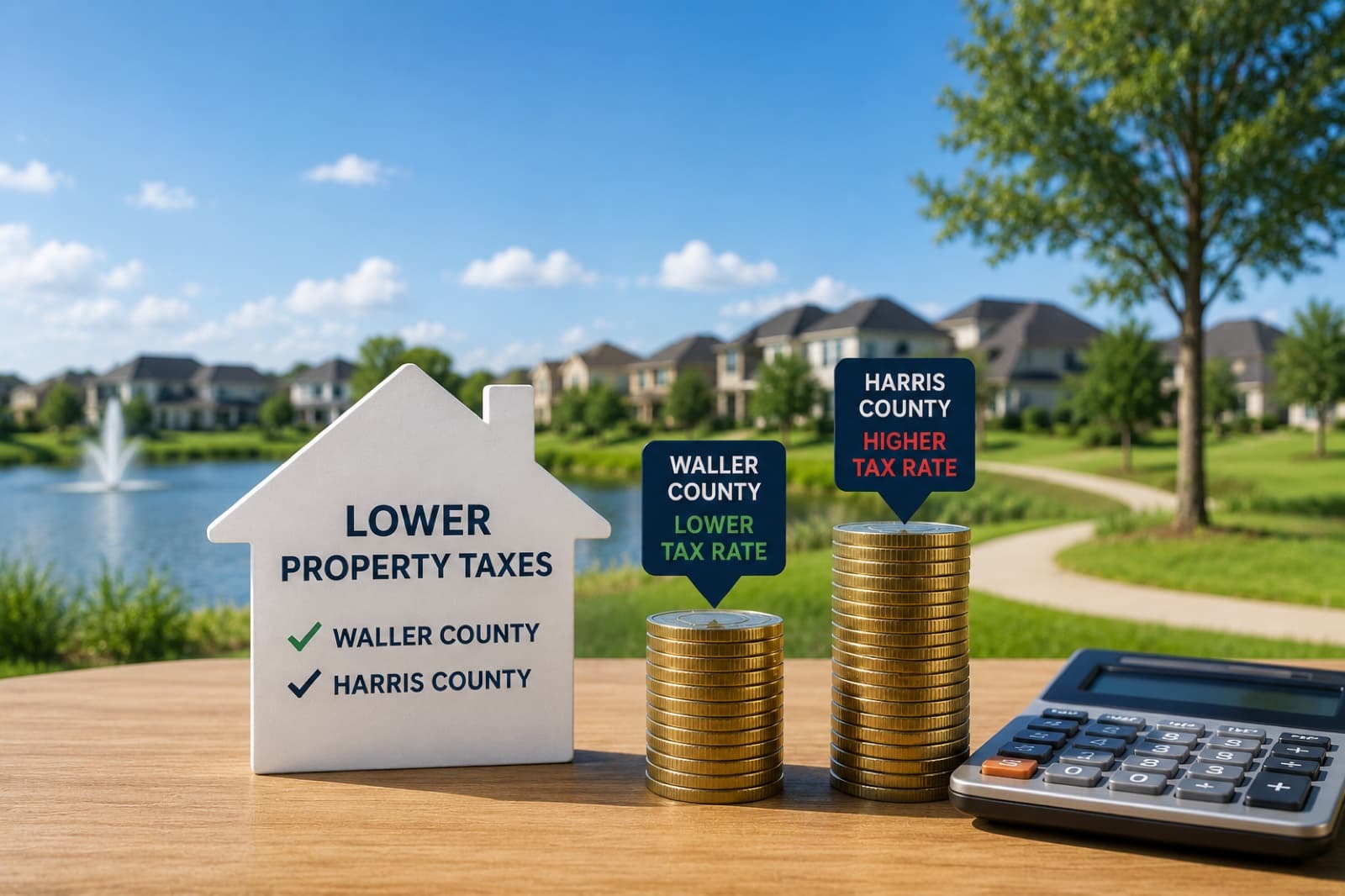
That county line is also where the comparison with Harris County comes in. Waller County's property tax rates run lower than those in neighboring Harris County, and the gap compounds. On a $500,000 home, even a 0.25% difference in effective tax rate equals roughly $1,250 per year, or more than $100 per month. For a family staying in a home a decade or more, that difference adds up to real money. The school district side of the ledger works the same way: Sofi Lakes is zoned to Royal ISD, which carries a lower school district tax rate than Katy ISD, the district serving more centrally located Houston-area communities. Two similar homes in adjacent neighborhoods can carry meaningfully different tax bills simply because of where the county and district lines fall.
The single most important thing a new homeowner can do about that bill is file the homestead exemption. It's a one-time, free filing made through the Waller County Appraisal District by April 30, and as of the 2025 tax year the school district exemption removes $140,000 from your appraised value before school taxes are calculated. Just as valuable is the cap that comes with it: once your homestead exemption is in place, your taxable value cannot increase more than 10% per year, no matter what the market does around you. In a community that's actively building out, that cap is your protection against sudden jumps as neighborhood values rise.
If you're over 65, disabled, or a qualifying veteran, additional exemptions stack on top of the standard homestead benefit. The over-65 exemption adds another $60,000 school district exemption and locks your school district taxes at the amount you paid in the year you qualified, a ceiling that can only go down. These aren't small details. They're the difference between a growing tax burden and a stable one.
Buying new construction changes the picture in your favor too, at least early on. The appraisal district values land and improvements separately, and a newly built home can take time to reach its full assessed value, so early buyers often see a lower bill in the first year or two than a comparable resale home would carry. A resale home, by contrast, is appraised close to its recent sales price from day one, which means its homestead cap starts from a higher base. Buying new sets your exemption baseline lower from the start. New homes built to current code can also unlock federal energy efficiency credits or deductions that older resale properties don't qualify for, though the specifics change year to year and depend on your home's features.
One caveat worth naming plainly: some far-west developments carry new Municipal Utility District debt, and MUD rates in the early years can offset part of the county-level savings. Before writing an offer on any new construction in the Katy metro, request a property-specific tax estimate from your lender or the appraisal district. The estimate breaks out the county, school, MUD, and special district components, and it's the only way to compare apples to apples across neighborhoods.
Once you own the home, Waller County collects on a clear calendar. Tax statements arrive in October. The deadline to pay without penalty is January 31. If you miss that date, penalties and interest kick in on February 1 and climb fast. co.waller.tx.us shows that by February 1, you owe 6 percent penalty plus 1 percent interest. Wait until July, and that jumps to 12 percent penalty and 6 percent interest combined. By January of the following year, unpaid taxes carry a 24 percent penalty and interest charge. The math gets painful quickly, so marking January 31 on your calendar is not optional.
Your Waller County appraisal determines what you owe. The Waller County Appraisal District decides your property's taxable value and whether you qualify for exemptions. If you disagree with the appraisal, you work with that district, not with Katy. The tax office receives the appraisal data and bills you based on it. This is worth knowing because it means your tax questions go to Waller County resources, and getting accurate information means reaching out to the right office.
Waller County has been growing steadily. According to recent communityimpact.com reporting, the county has seen a 355 percent increase in property tax revenue from major development projects between 2015 and 2023. That growth has brought road improvements and infrastructure investment. The county passed a $280 million mobility bond in November that includes five Katy-area road projects. Infrastructure is being built to match the pace of new homes like those at Sofi Lakes, and your property taxes fund that investment directly.
Taxes in Waller County are not a surprise. The system is predictable, the deadlines are fixed, and the rates are set in September each year. What changes is the appraised value of your home as the community builds out around you. That's normal in a growing master-planned community, and it's exactly what the homestead cap exists to smooth out. Know the process, file the exemption by April 30, and plan to pay by January 31 every year. Those two dates, plus one property-specific estimate before you buy, are most of what separates a straightforward tax bill from an expensive one. For worked examples and a side-by-side county comparison, see our Waller County property-tax guide — and for the fine print on your own situation, a tax professional or your builder can run the numbers once you've picked your lot.